String instrumentalists will need to equip themselves with the support materials needed to begin playing their instruments.
- EQUIPMENT
Shoulder Rests
Violinists use the correct sized shoulder rest to assist with
properly holding their instrument in playing position.

Important Features to Look For:
· Pivoting Feet
· Adjustable Height/Length
· Collapsible Feet
· Corresponding Size to Violin
Reputable Brands:
KUN Collapsible - $24
FOM (replica of KUN) - $12
Wolf - $25
Everest - $18
Prices reflect approximate market value.
Cello Endpin Anchors

This style of endpin anchor has become one of
the most popular on the market today.
· Anchors Directly to Seat
· Prevents Cello from Slipping
· Lightweight and Compact
· Durable
Approximate market value: $12-$15
Cellists use an endpin anchor to ensure the
cello remains stationary while playing.
Strings
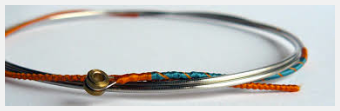
Recommended Brands:
· Thomastik · Pirastro
· Corelli · D’Addario
Suggested Brands to Avoid:
· Red Label · Black Diamond
Synthetic-Core Strings
Recommended - the current leading string type.
Synthetic-core strings are made from various types of synthetic materials, including nylon (from which perlon and stabilon are made), and composite fibers. They tend to produce a richer, fuller, and warmer tone quality than steel-core strings. Generally, they display greater complexity and a wider spectrum of tone colors. They're also capable of more subtle tonal effects than steel. Many have been developed to assimilate the desired warmth and feel of gut-core strings, but, unlike most gut strings, their pitch tends to stabilize fairly quickly after installation. In light of the aforementioned characteristics, synthetic-core strings are now the most popular type of string for bowed string players. Dependent on the unique properties of each individual instrument, the projection and response of these strings can vary. Additionally, composite-core strings are synthetic-core strings which represent the latest in advancing string technology. These are made with new types of synthetic materials, combined in new ways to create denser, stronger strings which are immune to temperature and humidity changes.
Gut Strings
Gut strings provide warm, rich tone quality, and complex, colorful sound with the plentiful overtones produced when played. Gut strings come in either plain (pure) unwound gut, or as a gut-core string wound with metals. They come in various gauges and can vary greatly in volume and response, depending on the instrument they are strung on.
Plain (pure) gut strings (unwound) are used on stringed instruments with Baroque set-ups (the E, A, and sometimes D strings on violins; the A and D and sometimes G of violas and cellos). Rarely, an instrumentalist will use pure gut on the upper strings of an instrument with a modern set-up.
Wound gut strings (with aluminum or silver) are often used on the lowest strings of instruments with Baroque set-up, and are used on instruments with modern set-up by players seeking the deepest, most colorful effects from their instruments. The volume of gut strings depends on the instrument they are strung on. While quiet on some instruments, on others they can actually create a more projecting sound than synthetic or steel-core strings. The brands differ in response and tone and come in different gauges or tensions. Experimenting with different gauges on your instrument can be very illuminating.
Steel-Core Strings
Steel-core strings are thinner in diameter than synthetic or gut strings. In general, they have a simple, bright, well-focused sound, a very quick response, and they maintain good pitch stability. As with synthetic-core strings, the projection produced depends on the uniqueness of the instrument itself. Generally, they will give a well-adjusted instrument an edgy, thin, and cutting quality of sound. They are often used by jazz, country, bluegrass, rock and alternative string musicians.
Loop or Ball End?
Most instruments require ball-end strings. This is determined by the set up of your instrument’s tailpiece. Please consult your instructor before purchasing strings as they are non-returnable.
Music Stands

Professional grade stands (built to last a lifetime):
· Manhassett - $40 (basic)
· Hamilton - $35 (basic)
· ProLine - $35 (basic)
Prices reflect approximate market value.
Rosin

Rosin is essential. In the world of rosin, low-cost rosin really does equate to low quality rosin, lending a harsh raspy sound. Although many rentals and factory made instruments are provided with a cheap cake of rosin, when purchasing replacement rosin, here are a few things you should know.
Two Basic Types of Rosin: Light vs. Dark
”Light” rosin does not always equate to light color as in the case of some cello rosins, but most of the time light rosins are also light in color.
Light rosins are a bit harder than their softer counterparts, dark rosins. Light rosins are suitable for summer months when temperature and humidity levels are higher. Dark, softer rosins, are well suited to dry, cold environments. Expect to pay $10 or more for a good quality rosin which will last many years.
Recommended Rosins:
· Jade – low dust, smooth action yet firm grip; professional grade
· Hidersine Deluxe - good for drier climates
· Pirastro Olive
· Hill
The following properties are each different with individual rosins: tone, amount of rosin dust created, amount of grip, and clarity of sound.
- BOOKS - Not all studio literature is showcased here.
Standard Method Books used at ReadyPlay Studio
Suzuki Series

I Can Read Music Series


New School of Cello Studies, Krane

Wohlfahrt Series

Previous/Revised Editions
Melodious Double-Stops, Trott

Fiddle

- MERCHANTS
Online:
Storefront:
North Country Music
Big Apple Music
With some storefront merchants, orchestral string instrument knowledge and product availability may be limited. Please consult your instructor prior to substantial or questionable purchases.
TO AVOID PURCHASING AN INCORRECT PRODUCT OR POOR QUALITY MATERIALS, PURCHASES SHOULD BE ADVISED BY YOUR INSTRUCTOR.
